
Social Media
Does the First Like Shape the Comments That Follow?
The first vote a comment receives can influence how later users judge it. The tone of a comment section can also shape how newcomers to the discussion behave, which is why brands need to track how engagement develops.
BraindPower
October 26, 2026 · 5 min read
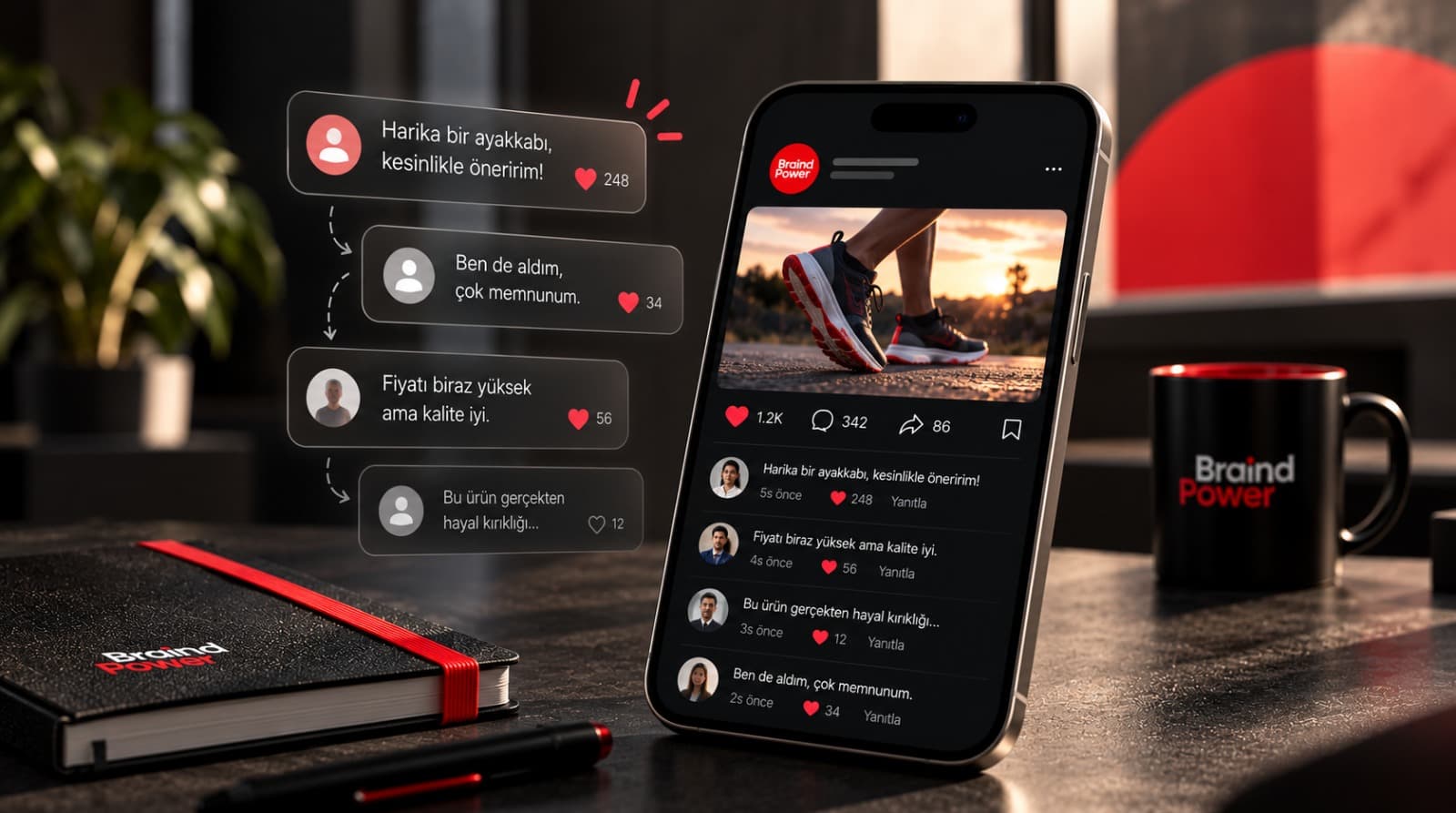
The first vote a comment receives can influence how later users judge it. The tone of a comment section can also shape how newcomers to the discussion behave, which is why brands need to track how engagement develops.
When you look at other comments before writing one under a brand's post, other people's reactions become part of your judgment. The same opinion can look different to you depending on whether it is widely liked or nobody has reacted to it. In a thread where harsh remarks follow one another, you may rethink the language of your own comment. Research shows that these signals in comment sections can influence our later behavior.
The first positive vote can influence later evaluations
The social influence experiment by Lev Muchnik, Sinan Aral and Sean Taylor, published in Science in 2013, followed 101,281 comments on a news-sharing site for five months. The comments were randomly divided into three groups. Comments in one group received a single upvote at the moment they were published, those in another received a single downvote, and the control group was left untouched. Users were unaware of this arrangement.
The first user to see a comment that had been given an initial upvote was 32% more likely to upvote it than in the control group. The text of the comment had not been changed; what changed was the starting score the user encountered. Downvotes, on the other hand, did not accumulate in the same way, and later users' upvotes tended to offset that intervention.
What the study measured was voting on an existing comment. It cannot be concluded from this that the first like directly determines the content of comments written later. Nor can the same rate be expected for every post on Instagram or YouTube. The findings show that when assessing the support a comment has received, the effect of earlier votes needs to be taken into account.
The language of a discussion can carry over into new comments
A 2017 study focused on how new comments are written: researchers from Stanford and Cornell universities ran an online discussion experiment with 667 participants. Participants commented under the same political news story. Some first encountered aggressive comments, while others saw comments containing no personal attacks. The researchers also altered participants' mood with an easy or difficult test given before the discussion.
Both a negative mood and seeing previously posted aggressive comments increased the likelihood that participants would write comments that disrupt the discussion. In the study, such behavior was assessed using criteria like insults, personal attacks and statements that pull the conversation off topic. So not every critical comment fell into this category.
This experiment does not prove that negative comments on a brand account necessarily stem from one another. It does suggest, however, that a comment section can set an example of behavior for newcomers. That is why separating users who report the same problem from users who insult each other makes sense for community management.
Visible rules can change the course of a discussion
What is shown at the top of a comment section is something brands can work on. In a field experiment published in PNAS in 2019 by J. Nathan Matias, 2,190 discussions in Reddit's science community were examined. A message explaining unacceptable behavior and how the rules would be enforced was pinned to the top of randomly selected discussions. The message was not shown in the other discussions.
In discussions where the rules were shown, first-time commenters were more likely to follow them, and contributions from new participants increased. Existing moderation practices continued throughout the experiment. This finding supports the idea that stating behavioral expectations openly can work. An approach that can be adapted for a brand account is to leave room for criticism while enforcing the limits on personal attacks in a clear and consistent way.
Track the evolution of comments with BraindPower
For a brand team to decide what to publicly clarify and in which discussions to remind people of the behavior rules, it needs to see the content of the comments. BraindPower analyzes social media mentions and user comments and helps track sentiment distribution and prominent topics. This gives your team a starting point for reviewing conversations that are intensifying.
For example, under an event video, comments about sound quality may increase while some users begin to attack one another. By reviewing the comments it monitors through BraindPower, your team can separate statements that report technical problems from personal attacks. The first group calls for explaining the issue or sharing a solution, while the second may call for enforcing the comment rules. A general negative sentiment score alone does not explain which of these two needs stands out.
After your reply, you can also track whether the same question is asked again and whether the discussion continues. The data BraindPower provides helps you make this assessment on the basis of concrete comments. That way, in comment management, besides replying to the most liked statement, you can make room for questions awaiting an answer and for the language of the discussion.


