Content Strategy
Why Are Negative Headlines Clicked? The Gap Between Attention and Trust for Brands
A headline catching attention is not the same as it meeting the reader's expectations. Evaluating content performance for brands means looking beyond click-through rate to the user reactions that follow the content.
BraindPower
October 12, 2026 · 7 min read
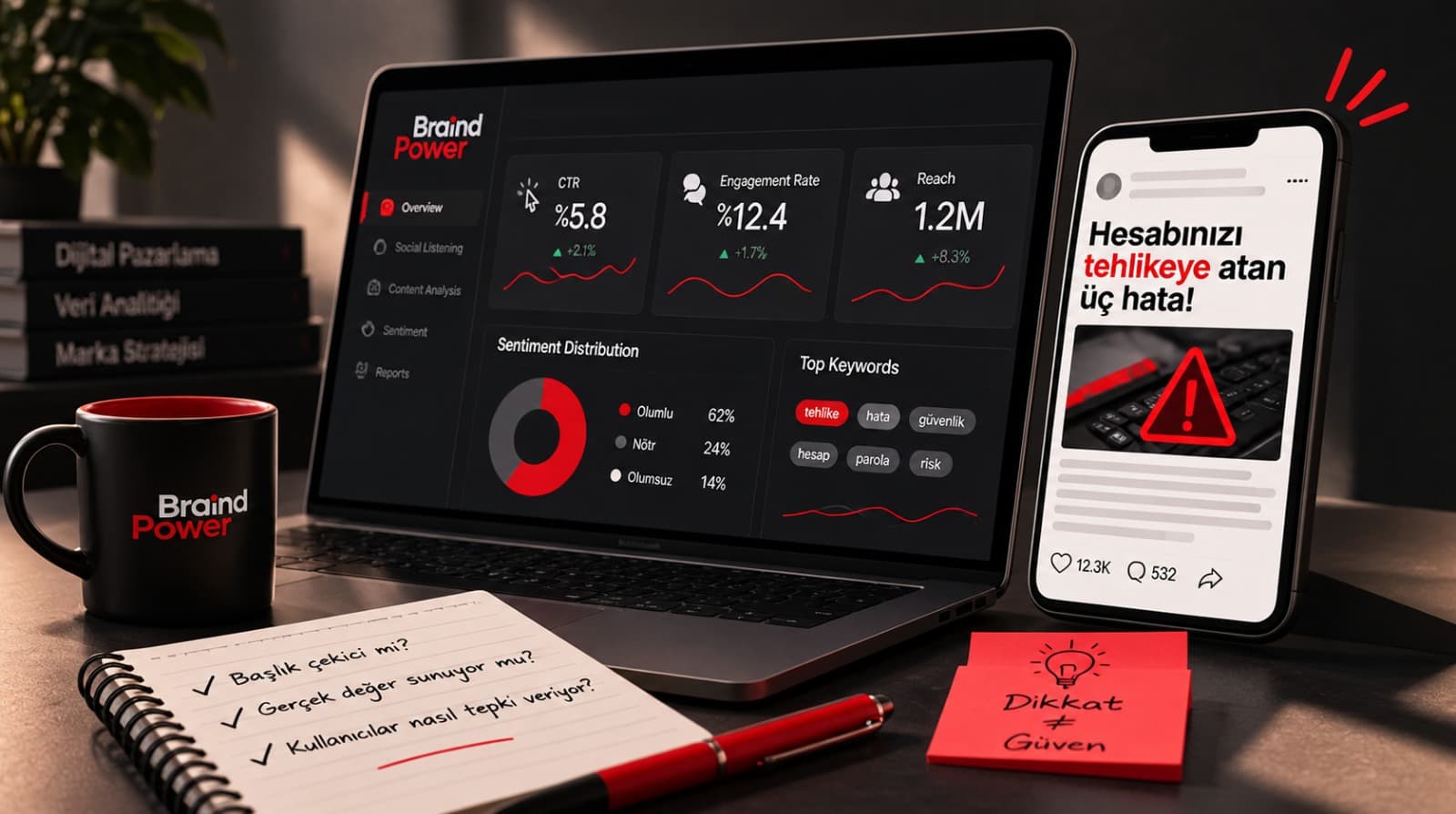
When you see a headline like "Three mistakes putting your account at risk," you may start thinking about your own habits. A headline like this appeals to the wish to notice a possible problem. But clicking on it doesn't, on its own, show that you found the content useful or that you trust the brand that published it.
That's why, when choosing a headline, it isn't enough to ask only "How many people clicked?" What expectation did the reader come with? Did they find the information they were looking for in the content? What did they say after sharing it?
BraindPower helps you track digital conversations about your brand with its social media analysis and sentiment analysis features. That way, alongside click data, you can add an assessment of how users react to your content.
The effect of negative words on click-through rate
A study published in Nature Human Behaviour in 2023 examined data from the publishing site Upworthy for 2013–2015. Different headlines for the same story had been shown to visitors at random. This allowed the researchers to compare how the language of the headline affected clicks while the topic of the story stayed the same.
After filtering, the analysis included 12,448 experiments, more than 53,000 headlines and more than 205 million impressions. The study calculated that each additional negative word in an average-length headline increased the click-through rate by about 2.3% relative to the existing rate.
The increase here is not 2.3 percentage points. For example, applying a 2.3% relative increase to a 1% click-through rate gives roughly 1.023%.
This finding doesn't mean that adding negative words to a headline will produce the same result on every platform. The study looked at news from a single English-language site over a particular period. It also didn't measure whether readers trusted the brand.
Negativity can grab attention, but not equally for everyone
The tendency to give more weight to negative information and react more strongly to it is called "negativity bias" in psychology. A study published in PNAS in 2019 evaluated this tendency through news videos in 17 countries. While 1,156 participants in total watched the news, physiological indicators such as heart rate variability and skin conductance were measured.
On average, participants showed a stronger physiological response to negative news. However, the differences between individuals were large. The researchers pointed out that the audience who might be interested in positive news content should not be overlooked either.
So we can't conclude from this tendency that every reader constantly wants to see negative content. For brand communication, the distinction to draw is this: a piece of content catching attention doesn't show that the reader liked it or found its tone appropriate.
The difference between clickbait and a negative headline
At this point, clickbait needs to be separated from negative headlines. Clickbait headlines may hide the key information that would let the reader understand the topic, or exaggerate what the content offers, in order to push the reader to click. A positive promise can be used for the same purpose. So a headline being negative does not make it clickbait by itself.
For example, the headline "Three password mistakes that weaken account security" tells the reader what they'll be reading, provided the content actually explains these mistakes.
The phrase "If you make this mistake, you could lose your account any moment!" hides what the mistake is and leaves the scale of the risk vague. If the text doesn't support this threat, a mismatch arises between the expectation the headline creates and the information it delivers.
So how does clickbait affect trust? A two-experiment study published in Public Opinion Quarterly in 2020 found no effect of reading clickbait headlines on trust in the media under the conditions examined. So the research doesn't support the conclusion that "clickbait headlines necessarily reduce trust." Likewise, the finding can't be generalized to "clickbait never affects trust."
Moreover, trust in news media and trust in a particular brand are not the same assessment. The practical lesson for brand communication from these studies is to treat clicks and trust separately. Whether a headline sparks interest should be assessed with click data; whether the reader's expectation was met should be assessed with the feedback they give after the content.
Understanding the reactions that follow a headline with BraindPower
For a brand, evaluation doesn't end when the content is published. BraindPower's social media analysis module helps you track mentions and user comments about the brand and classify content as positive, negative and neutral. Conversations across different digital sources such as X, Ekşi Sözlük, news sources and YouTube can be examined from the same platform.
For example, a piece you wrote on digital security may receive many comments. Are users describing their own experiences in these comments, asking about your recommendations, or finding the headline exaggerated?
You can examine the comments you track through BraindPower with these questions. That way, in your next headline decision, you take into account not only how many people reacted, but also what they said and which topic they reacted to.
Here, the result of sentiment analysis needs to be read in context. Users being angry about a security problem doesn't mean they're angry at your brand. Examining what negative comments are directed at helps you assess whether you need to change the headline or the text.
You can evaluate the data from BraindPower together with your website's click measurements. However, sentiment analysis results shouldn't be interpreted directly as a measure of brand trust. To assess brand trust, you should also consider user feedback and research that asks about trust directly.
This approach can help you develop your content strategy not only around getting more clicks, but around readers' information needs and their reactions.
What matters is not just writing a headline that grabs attention, but understanding what kind of conversation forms after it.